


Okay, so before we get started apparently you’re supposed to put a picture in these things because of something called the algorithm. This is confusing to me because I was sure Tom Cruise and/or Daniel Craig defeated the algorithm in some sort of bunker several years ago. But anyway here’s a picture. Please just remember after you look at it to keep scrolling to the words because they are the main bit.
“Right, how are we doing belonging?”
I’d imagine that this question has featured in hundreds of SLT meetings over the last year or so. It’s a perfectly reasonable question to ask. Whether it’s in response to lagging attendance, fear of Ofsted, or a genuine desire to make the school a more welcoming and vibrant place, schools want to know how they can do belonging.
The problem is you can’t.
That’s because the question rests on a faulty assumption; that belonging is something that is external, to be delivered, or achieved. This misconception tends to lead to tokenistic and superficial fixes, like commissioning a mural saying ‘You belong here’, holding an affirming assembly at the start or the year, or having a drop down PSHE day.
These aren’t necessarily bad things to do, and are certainly defensible.1 It’s understandable. Schools are busy places. Leaders have a ton of competing priorities, and everything is important. And with the recent wave of interest in belonging, there’s no shortage of consultants or publishers willing to throw together a quick fix and sell you a dream of solving a legitimate and thorny challenge with a really quite pretty AI generated poster.
Belonging is a process
This is frustrating. It would be really nice to believe that belonging is something that is fixed, binary state, like whether or not a kid knows their 3 times tables or can tell you the four causes of the First World War. But belonging isn’t something that’s schools do, it’s something that children feel.
And not just children. All of us, all of the time, are either consciously or unconsciously making an evaluation of whether or not we fit in a particular environment. It’s part of being a human being, and probably traces back through our evolutionary psychology, where membership of the tribe would be life or death.
That means that we’re all constantly asking the question “Do I fit here?”, “Am I welcome?”, “Am I valued?” Gregory Walton coined the term ‘belonging uncertainty’ for this universal feeling. It’s not a charming quirk of teenagers, or a deficiency in small children. You probably experienced it when you started a new job, and maybe still feel it when you walk into the staffroom. I do it when I pick up my daughter from school and approach the group of parents at the gate.
It’s something we all do, and are particularly sensitive to in new environments, or environments with people who we don’t know closely.
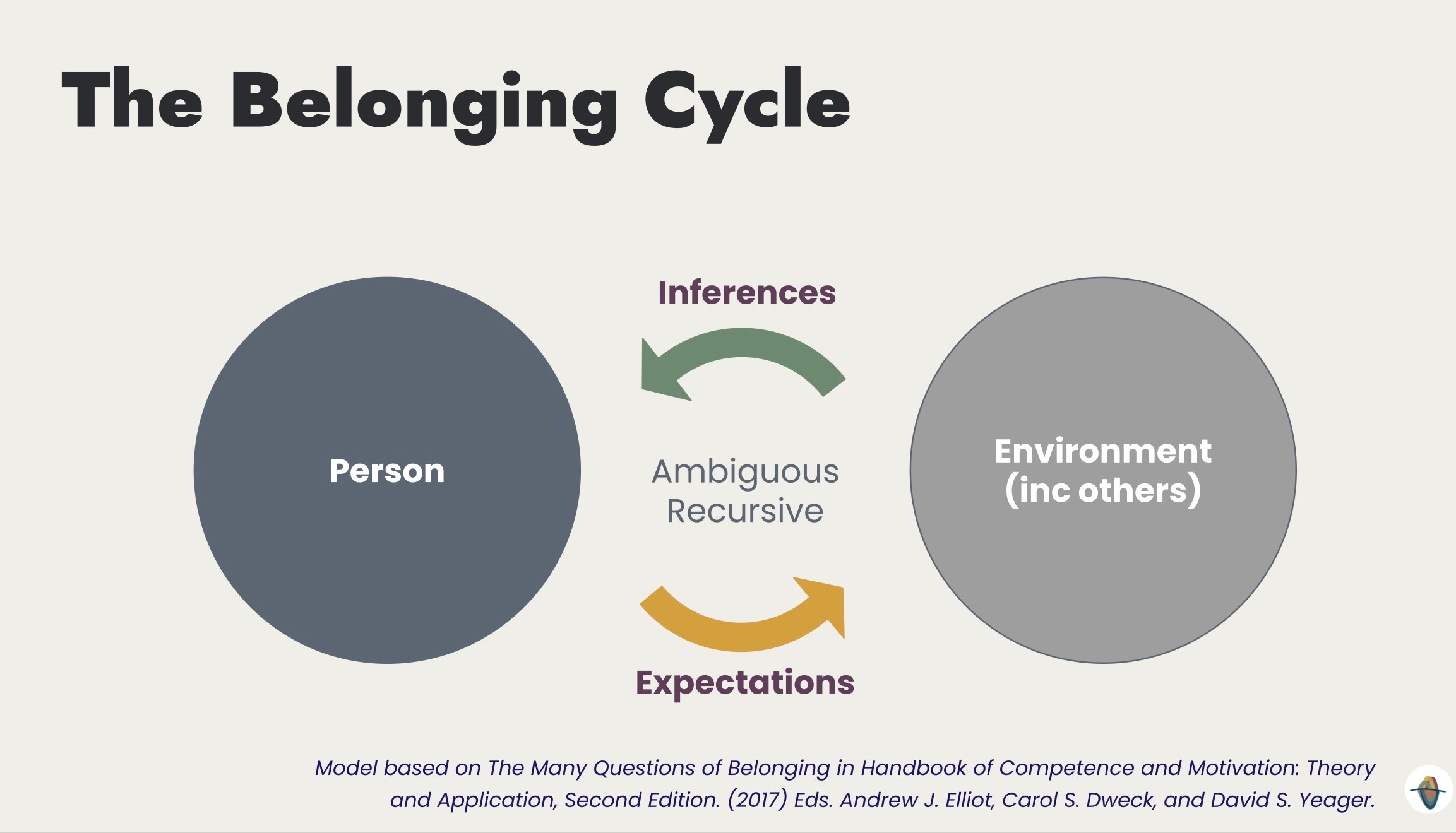
The feeling of belonging, then, is an internal judgement. And we make that judgment based on cues from our environment. These cues could be physical, like whether or not there is a coat peg with our name on it, but mostly they are interpersonal; they are based on the words and actions of others.
Ambiguous signals
One of the big problems with making these inferences about whether or not we belong is that those cues are usually ambiguous. The teacher looks at you with a frown when you arrive? Could be they’re having a bad day, or maybe something you did last lesson annoyed them and they would rather you weren’t there. Friends start giggling in the corner as you sit down, maybe it has nothing to do with you. But maybe…
There are obviously thousands and thousands of these signals being received almost every moment. But they aren’t only ambiguous, they are also recursive. That means that once you begin to infer that maybe you don’t belong, you become more primed for signals that confirm that judgement. The same is true in the other direction, but for most of us there seems to be an asymmetry: we’re much more sensitive to negative signals.
Belonging isn’t a state, then. It’s a dynamic and continuous evaluation playing out in everyone’s head based on ambiguous signals from the environment we find ourselves in and the people that we share it with.
Expensive, simple, and wrong.
There are a couple of things that follow from this. First, the unit of belonging is the classroom. It may appear as a development priority on an SLT agenda, but it’s not something that we can meaningfully shift at a whole school level. Sorry.
Second, it means that belonging isn’t something that teachers do. It’s everything that they do.
This makes it different from so many other challenges, which can often be addressed with an intervention, or a better resource, or an additional member of staff. In some ways that’s pretty uncomfortable: there isn’t a programme that you can buy or a keynote speaker that you can hire that means you’ve ‘done’ belonging. As H.L. Mencken put it, for every complex problem there is an answer that is clear, simple and wrong. I’m not sure it gets more complex than human belonging, in classrooms, with large groups of children.
But in other ways it liberating. First, it’s cheap!2 It depends on how teachers interact with pupils and set up the conditions for them to interact with each other. That doesn’t cost anything. It’s also work that most teachers that I’ve met genuinely welcome. They got into the job because they like kids. They want them to succeed and make progress in the curriculum, yes, but they also want to get to know them, for them to look forward to coming into their classroom, and for them to feel safe, welcome and valued while they are there.
So no, you can’t do belonging. It lives inside children’s heads, based on some stuff that is out of your control, and plenty of stuff that the teacher can orchestrate. But the only way to minimise the chances of belonging uncertainty becoming the default judgment of most kids is through the culmination of a million totally ordinary interactions.
And if you’re thinking ‘well that all sounds lovely, but we don’t really have time for that - there’s stuff to learn!’ I hear you. But there’s quite a lot of evidence that a secure sense of belonging is a key enabler for pupils to tackle rigorous content.
In the next post, I’ll share a bit more about just that.
There is some evidence to suggest that these whole school initiatives could backfire though: if you’re uncertain about whether or not you belong, these heavy handed messages could confirm to you that you don’t. And none of them really get to the true root of the matter.
Ironically, this can be a problem. Schools tend to take more seriously, and invest more time and and attention, in things that they’ve paid for.
This is great - and not something I think we talk about enough in the T&L community. It not only makes for a happier place to be for students and staff when there is a sense of belonging, but the worries and questions it can create for students who don’t feel they belong, leads to a hidden cognitive load they are juggling while also trying to learn.
Love this - the "who we are not what we do" is such a huge mantra.
Think educations consideration of ideas of belonging could stand to take a closer look at other 'belonging' focused organisations. The idea of being part of something bigger than yourself 'legacy' (whilst not just a superb book by Kerr) is a strong unifying concept. We should look at sport, the military and some long standing social organisations for clues about how this is done well.
Social signifiers of being part of a group and that group association of behaviours and conceptal alignment is such an interesting piece of social psychology. Military 'espirit de corp' is an absolute key part of understanding some of this. Small traditions and routines that bring about a sense of belonging.
Highly effective social groups are at the very heart of humanities evolution - we are hard wired to seek identification and group. Meaning and fulfillment is about contribution. Intrinsic motivation to contribute and be 'owned' by others.
Scruffy ideas but I've done this in schools successfully and will be shortly doing this again. I can signpost some really practical thinkers and one current practitioner who excels in this if any one is interested let me know.